CBCT Artifact Management: Metal, Motion, Beam Hardening, and Reconstruction Algorithms
How CBCT operators manage imaging artifacts — metal streak artifact from implants and restorations (MAR algorithms), motion artifact prevention and compensation, beam hardening correction, ring artifact and detector calibration, aliasing, cone beam artifact (Feldkamp), iterative and model-based reconstruction approaches, and equipment specifications for robust artifact handling from Shanghai.
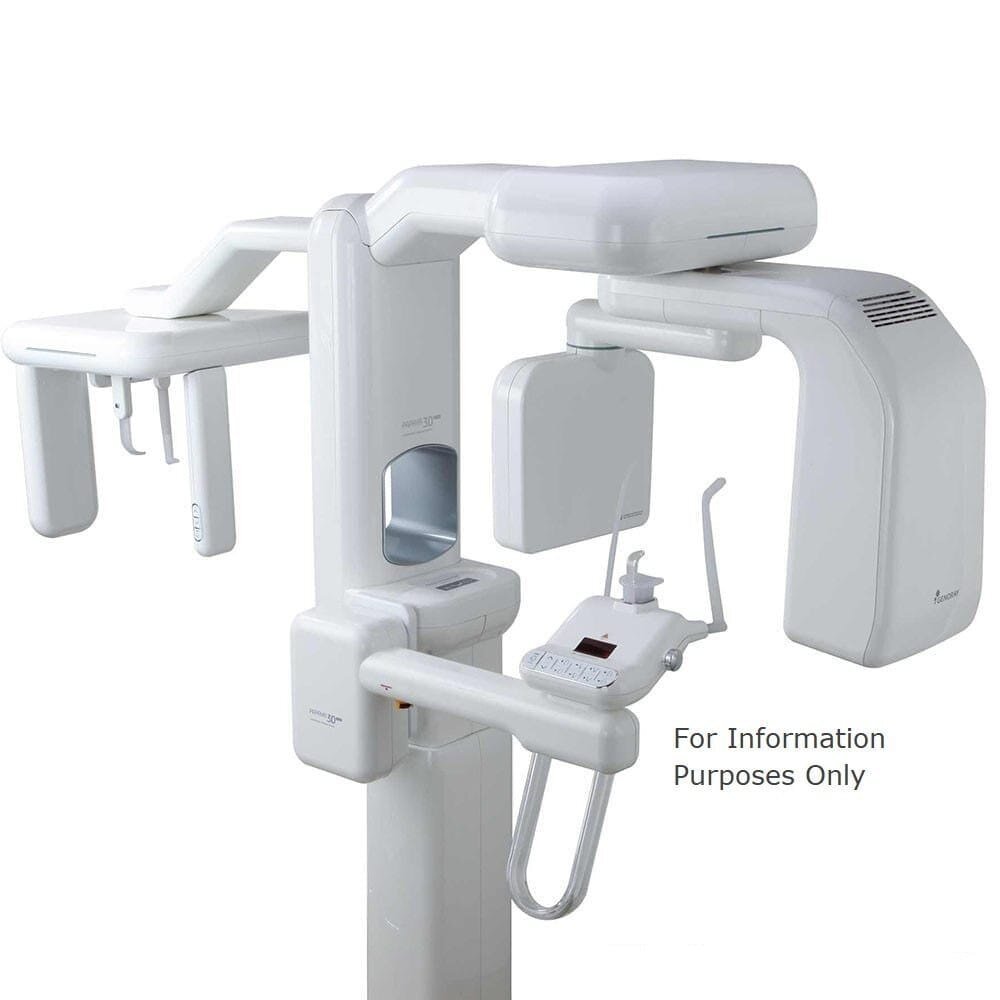
CBCT image artifacts are distortions or errors in the reconstructed 3D volume that obscure anatomical detail or create misleading imaging features. Managing artifacts — preventing them when possible, recognizing them when present, and minimizing their clinical impact through hardware and software approaches — is essential to CBCT diagnostic quality. This guide walks through the major CBCT artifact categories, their causes, prevention strategies, and equipment specifications that matter for artifact management in practices sourcing CBCT from Shanghai.
Metal streak artifact
Cause
Metal restorations, metal implants, metal posts, orthodontic brackets, and metallic dental work cause beam hardening (selective attenuation of low-energy X-rays), photon starvation (insufficient photons reaching detector), and partial volume averaging issues. These combine to create streaking artifacts radiating from metal structures across the reconstructed volume.
Clinical impact
- Obscures peri-implant bone detail (critical for implant assessment)
- Obscures root canal anatomy in teeth with metal posts or crowns
- Obscures bone detail adjacent to metal restorations
- May mask peri-apical pathology in endodontically treated teeth
- Can cause false positive caries or pathology appearance due to artifact shadowing
Prevention strategies
- Limit metal in scan volume: when clinically feasible, target scan volume away from known metal
- Proper patient positioning: position non-target metal outside primary beam where possible
- Remove removable appliances: take out partial dentures, retainers, and other removable metal before scanning
- Increased kVp: higher kVp reduces beam hardening (90–100 kVp vs 80 kVp protocols for metal-rich dentition)
- Consider patient dentition before scheduling: patients with extensive metal restoration may have limited CBCT diagnostic value
Software correction
- Metal Artifact Reduction (MAR): software algorithms detect and compensate for metal-induced artifacts
- Available on: most modern mid-tier and premium CBCT units; rare on entry-tier
- Effectiveness: good MAR reduces artifact severity by 50–80%; does not eliminate
- Reconstruction time penalty: MAR reconstructions take 2–4× standard reconstruction time
- Specification to verify: “iterative MAR” or “projection-based MAR” vs. simpler interpolation approaches
Motion artifact
Cause
Patient movement during CBCT scan (typical 10–20 seconds) causes inconsistency between projection images, leading to double-contours, blurring, and streaking in the reconstruction.
Clinical impact
- Blurred anatomical structures
- Double-contour appearance of bone, teeth, and soft tissue
- Peripheral streaking radiating from high-contrast structures
- Can make images unusable if severe
Prevention strategies
- Patient positioning: proper head stabilization with cephalostat, chin rest, forehead support, lateral head supports
- Patient instruction: clear pre-scan instruction to remain still, close eyes, relax
- Pediatric cooperation: age-appropriate patient preparation; consider sedation for very young or uncooperative patients
- Shorter scan time: lower scan time (10–14 seconds) reduces motion opportunity vs. longer (18–22 seconds) scans
- Fast scan protocols: premium CBCT offer fast scan modes for motion-sensitive patients
- Second scan available: if first scan shows motion, rescan (accept slightly elevated dose for diagnostic quality)
Software correction
- Motion compensation algorithms: premium CBCT units include motion correction in reconstruction
- Partial effectiveness: compensates for limited movement, not severe motion
- Verification: operator should verify reconstruction quality and rescan if motion compromise is substantial
Beam hardening artifact
Cause
X-ray beam is polychromatic (contains spectrum of energies). Low-energy photons are preferentially absorbed by tissue, leaving beam “hardened” (higher average energy) after passing through dense structures. This creates intensity variations in the reconstruction that don’t correspond to true density variations.
Clinical impact
- Dark bands between dense structures (between teeth roots, between cortical bone surfaces)
- Cupping artifact (central region appears less dense than peripheral in cylindrical objects)
- Apparent density variation in uniform bone areas
- Can mimic caries, peri-apical lesions, or fractures
Correction approaches
- Hardware filtration: additional beam filtration (typically 0.1–0.3mm Cu or Al) hardens beam before reaching patient, reducing beam hardening
- Beam hardening correction algorithm: iterative correction during reconstruction
- Pre-calibration: manufacturer-calibrated correction tables for standard imaging protocols
- Available: essentially all modern CBCT units include beam hardening correction; quality varies
Ring artifact
Cause
Ring artifacts appear as concentric circles in the reconstruction, caused by detector element variation — specific detector pixels with different sensitivity or non-uniform gain that persist across all projections.
Clinical impact
- Concentric circular patterns in reconstruction slices
- Can obscure or mimic anatomical detail
- Typically mild to moderate; rarely severely compromises diagnostic quality
Prevention and correction
- Detector calibration: regular detector gain calibration per manufacturer schedule
- Flat-field correction: reconstruction includes per-pixel correction based on calibration data
- Ring artifact reduction algorithm: software detection and suppression of ring patterns
- Detector replacement: degraded detectors eventually require replacement (USD 15,000–35,000)
Aliasing artifact
Cause
Undersampling in projection space causes aliasing in reconstruction — patterns that don’t correspond to actual anatomy. Common in cases of insufficient projection count for the reconstruction volume.
Manifestations
- Stellate patterns emanating from high-contrast structures
- “Windmill” artifact in axial slices
- Most visible at image periphery
Prevention
- Adequate projection count: typical 400–600 projections per scan for standard reconstruction quality
- Full-rotation scan: 360° scan vs. 180° reduces aliasing
- Iterative reconstruction: more robust to undersampling than traditional filtered back-projection
Cone beam artifact
Cause
CBCT uses a cone-shaped X-ray beam and flat-panel detector. The cone geometry causes specific artifacts as projection angle increases from central axis — these artifacts worsen toward the superior and inferior edges of the scan volume (“Feldkamp artifact”).
Manifestations
- Reconstruction quality degrades at top and bottom of scan volume
- Streaking and blurring at edges
- Reduced spatial resolution off-axis
Prevention
- Center target anatomy: position clinically important anatomy at the scan volume center, accepting edge quality loss
- Appropriate FOV selection: don’t over-extend FOV beyond clinical need
- Advanced reconstruction algorithms: iterative or model-based reconstruction handles cone geometry better than simple Feldkamp reconstruction
Partial volume effect
Cause
When a single voxel contains multiple tissue types (e.g. bone and air at cortical boundary), the reconstructed value is an average of the constituent materials. This causes blurring of fine structures smaller than voxel size.
Clinical impact
- Fine structures smaller than voxel size are not sharply resolved
- Cortical bone thickness appears greater than reality at low-resolution voxels
- Small pathology may be missed or under-characterized
Prevention
- Appropriate voxel size: match voxel size to anatomical detail required
- High-resolution protocols for fine detail: 75µm or 100µm when fine structures matter
- Multi-planar reconstruction: viewing in different planes helps interpret partial volume effects
Reconstruction algorithms and artifact management
Filtered back-projection (FBP)
- Traditional, fast reconstruction algorithm
- Standard on all CBCT units
- Limited artifact handling
- Fastest reconstruction (few seconds)
Iterative reconstruction
- Iterative refinement of reconstruction to match projection data
- Better handling of low-dose, limited-projection, and metal artifact scenarios
- Available on mid-tier and premium CBCT
- Longer reconstruction time (1–5 minutes)
Model-based iterative reconstruction (MBIR)
- Incorporates physical model of imaging chain
- Best artifact handling, including metal, motion, beam hardening
- Premium CBCT feature
- Longer reconstruction (5–15 minutes)
AI-enhanced reconstruction (emerging)
- Machine learning models trained on paired high-quality / degraded imaging data
- Emerging in premium CBCT and advanced research applications
- Significant artifact reduction potential
Artifact management in procurement specification
Hardware specifications to verify
- Detector type: modern CsI or GOS flat-panel detector with good dynamic range
- Projection count: adequate projection count per scan (typically 300+ for standard, 500+ for high-quality)
- Beam filtration: appropriate hardware filtration
- Gantry stability: mechanically stable rotation
Software specifications to verify
- Metal artifact reduction: confirm availability and quality
- Iterative reconstruction: available as option
- Motion compensation: built into reconstruction pipeline
- Beam hardening correction: calibrated and validated
- Ring artifact reduction: available and operational
Calibration and QA protocols
- Regular detector calibration: per manufacturer schedule
- Phantom imaging: periodic imaging of calibration phantom to verify image quality
- Beam quality verification: kVp and filtration verification
- Geometric accuracy verification: spatial accuracy testing
Operator training for artifact awareness
- Artifact recognition: operator should recognize common artifacts vs. genuine pathology
- Second opinion workflow: when artifacts complicate interpretation, second opinion or additional imaging may be warranted
- Patient preparation: proper pre-scan preparation (remove removable metal, patient positioning)
- Protocol selection: matching protocol to clinical scenario minimizing artifact risk
- Documentation: noting imaging limitations when artifacts present in clinical report
When to rescan
Indications for rescan when artifacts compromise diagnostic quality:
- Severe motion artifact preventing diagnostic interpretation
- Patient cooperation improves after initial attempt (pediatric or anxious patient learning experience)
- Protocol selection was suboptimal (wrong FOV or voxel for clinical question)
- Unexpected diagnostic question arises post-scan requiring different protocol
Balance rescan decision against dose exposure; justify rescan as clinically necessary.
Chinese CBCT artifact management by tier
Entry-tier Chinese CBCT
- Basic beam hardening correction
- Standard FBP reconstruction
- Limited or no metal artifact reduction
- Adequate for routine imaging; may struggle with metal-rich dentition
Mid-tier Chinese CBCT
- Comprehensive beam hardening correction
- Iterative reconstruction option
- Basic metal artifact reduction
- Motion compensation
- Clinically competent for most applications including metal-affected cases
Premium Chinese CBCT
- Advanced iterative or model-based reconstruction
- Premium metal artifact reduction
- Comprehensive motion compensation
- AI-enhanced reconstruction (in latest premium units)
- Competitive with European premium brands on artifact handling
Common artifact management mistakes
- Assuming all CBCT images are diagnostically reliable: recognize artifact-limited images and don’t over-interpret
- Not using MAR when available: MAR provides meaningful clinical benefit; use for metal-containing cases
- Over-using MAR: MAR can introduce its own artifacts; evaluate images with and without MAR when available
- Ignoring motion: proceeding with motion-affected images when rescan is warranted
- Skipping detector calibration: ring artifacts and image quality degrade without regular calibration
- Under-specifying artifact capabilities at purchase: MAR and iterative reconstruction matter clinically; specify at purchase rather than discovering limitations post-installation
Sourcing CBCT with robust artifact management from Shanghai?
WhatsApp us with your expected patient dentition (metal restoration prevalence, orthodontic appliances in patients, etc.), primary clinical applications, destination country, and budget. We’ll propose CBCT options with appropriate artifact management capability (MAR, iterative reconstruction, motion compensation) matched to your clinical needs, discuss detector quality and calibration workflow, and quote FOB Shanghai pricing with full commissioning package landed cost analysis.
Chat on WhatsApp →Have a specific unit in mind?
Tell us which model you want and your destination port — we'll quote FOB or CIF with a video demo of the actual unit in our warehouse.