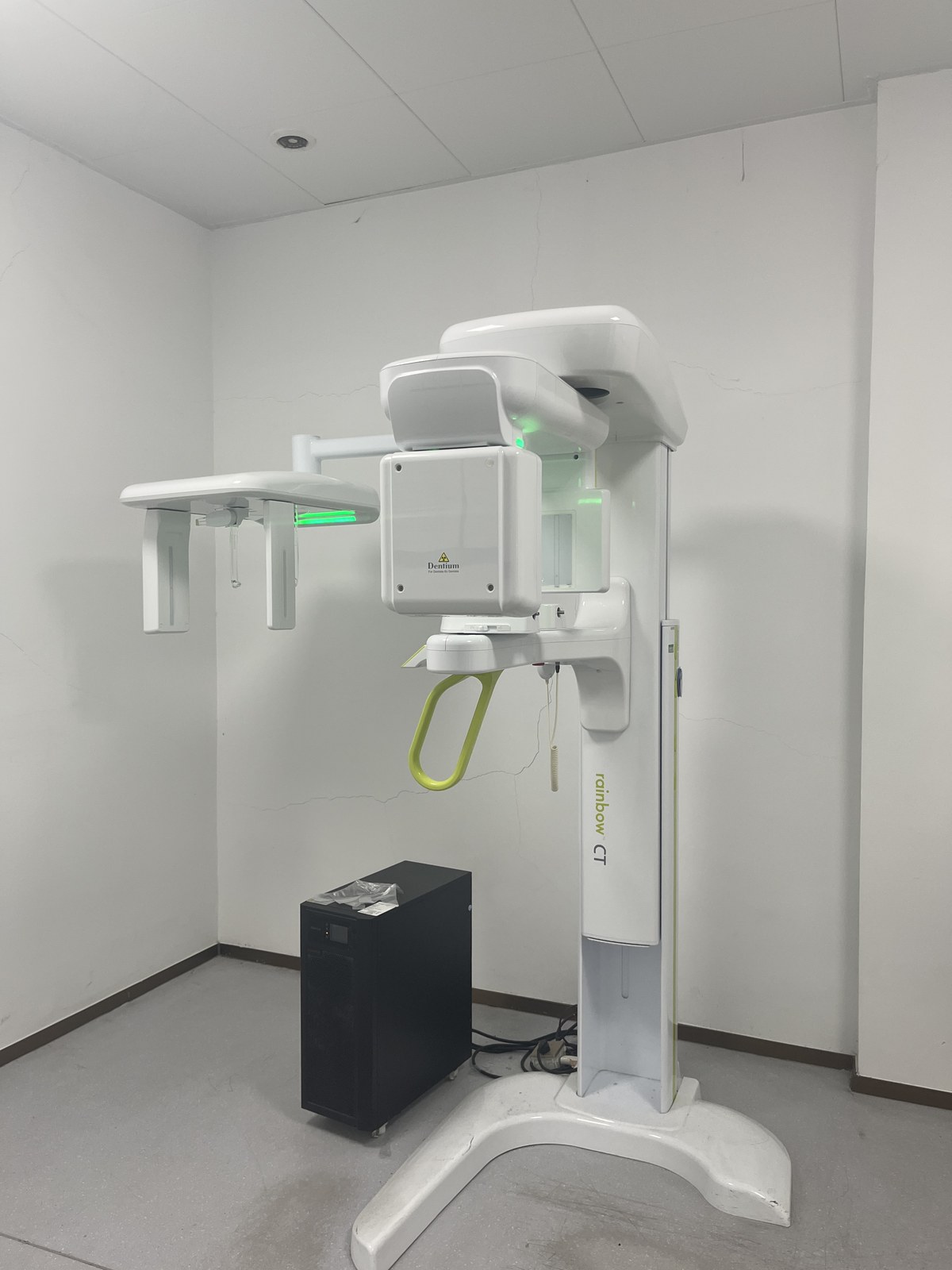
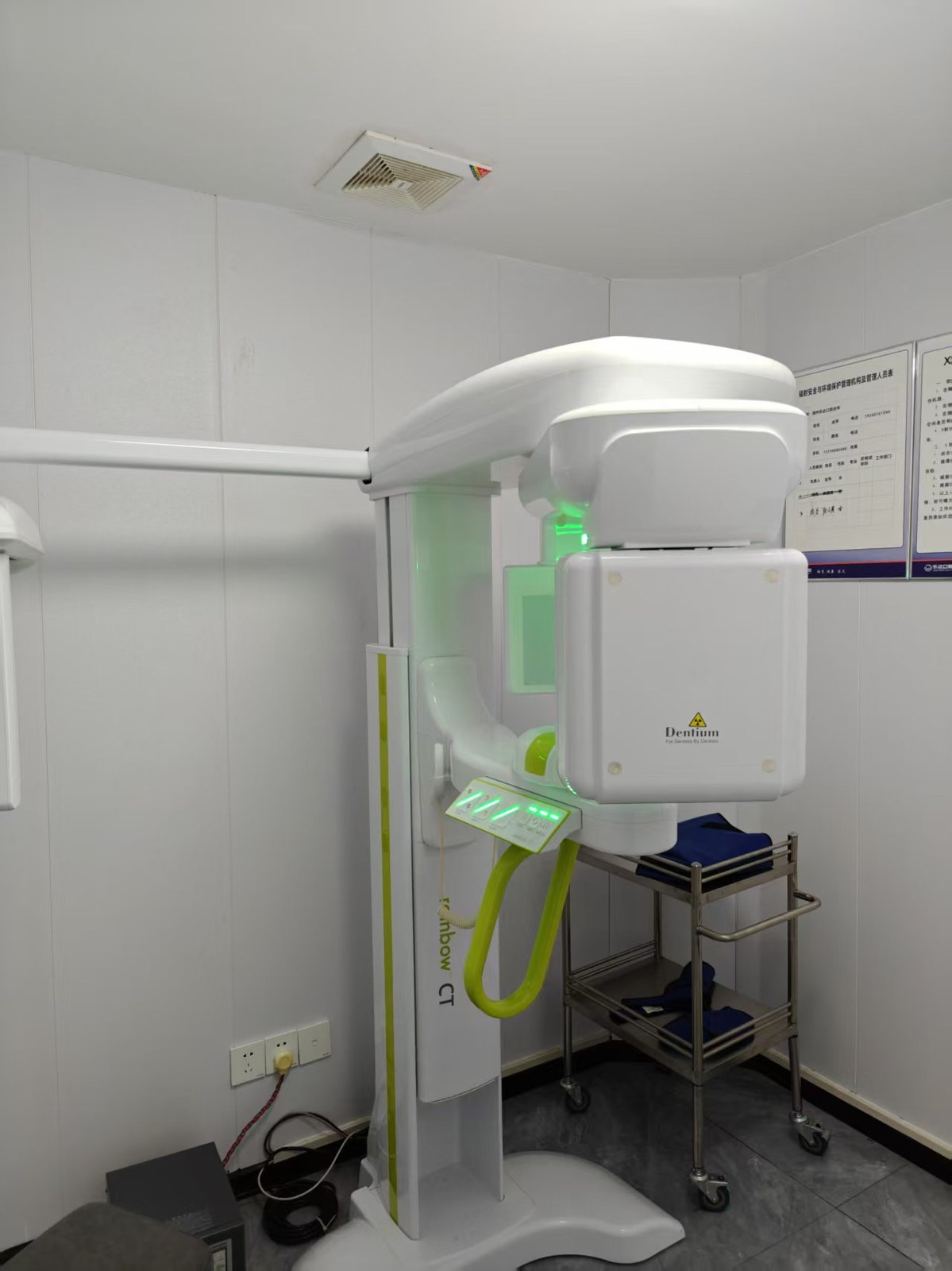
The Dentium Rainbow CT is a 3-in-1 dental CBCT from one of Korea's leading dental implant manufacturers — built so the scanner, the planning software and the implants speak the same language. Three FOVs up to 16 × 18 cm stitched, a premium CdTe direct-conversion cephalometric sensor, and a bundled HP Z4 workstation pre-loaded with the full rainbow software suite.
Dentium Co., Ltd. was founded in 2000 in South Korea and is today one of the top three Korean dental implant manufacturers alongside Osstem and Neo. Their SuperLine and Implantium implant systems are deployed in over 70 countries; their Chinese subsidiary (Dentium China) operates out of Guangzhou.
The Rainbow CT — introduced as part of their imaging push — uses the same "For Dentists By Dentists" design philosophy the brand built its implants around: clinically specific, feature-dense, and tightly integrated with the surgical workflow.
Rainbow CT's FOV catalogue is deliberately short — three clinically distinct modes instead of twenty quasi-overlapping ones. Each mode has clear rules for when to use it and which voxel setting to pick. The headline number is the Stitching mode: at 16 × 18 cm, this is one of the largest effective FOVs available on any dental CBCT, stitched from two sequential scans.
Dentium sells the Rainbow CT platform in two factory configurations: 3-in-1 (rainbow CT, serial
code DX) and 2-in-1
(bright CT, serial code BC).
Same chassis, same generator, same CT/pan detector — the difference is cephalometric capability, and
there is no onsite upgrade path.
Full 3-in-1 imaging suite. Dedicated cephalometric arm extending laterally from the main column with its own CdTe CMOS detector. Supports Lateral, PA/AP, SMV and Carpus projections.
Same CBCT and panoramic capability as the 3-in-1 — just without the cephalometric arm. Significantly smaller footprint (almost half the width) and lower price, suitable for practices that don't do orthodontic cephalograms.
Most dental cephalometric sensors are indirect-conversion: X-ray photons hit a scintillator (typically CsI or GOS), which emits visible light, which a photodiode array then reads. That two-step pathway loses spatial information at the scintillator.
The rainbow CT ceph arm uses a Cadmium Telluride (CdTe) CMOS direct-conversion detector. X-ray photons generate electron-hole pairs directly in the semiconductor, skipping the light-emission step entirely. For ceph tracings where fine skeletal landmarks matter, this typically means cleaner edges and better contrast-to-noise ratio per unit dose.
Rainbow CT's original factory package includes the imaging unit and the acquisition workstation — an HP Z4 G4 tower with an Intel Xeon CPU, ECC RAM, NVIDIA discrete GPU and Windows 10 Pro, pre-loaded with Dentium's full rainbow software stack. When you buy one of our refurbished units with the original workstation included, you're plug-and-play.
| Manufacturer | HP |
| Model | Z4 G4 Workstation |
| CPU | Intel Xeon W-2223 |
| RAM | 16 GB DDR4-2933 Reg ECC |
| HDD | 1 TB 3.5" HDD |
| GPU | NVIDIA GeForce RTX 3050 8 GB |
| Ethernet | Intel I210 T1 LAN + Serial |
| OS | Windows 10 Professional |
| Monitor | HP EliteDisplay E22 G5 · 21.5" FHD |
The Rainbow CT was designed with the implant case in mind, and you'll feel that in the planning software. But the three FOV sizes plus full cephalometric make it a general-purpose 3-in-1 that covers endo through maxillofacial without compromise.
Local mode with high-resolution 200 μm voxel. Dentium implant library pre-loaded in the 3D Viewer lets you drop-and-position virtual implants with live bone density mapping before surgery.
Dual arches back to the third molars in one volume — multi-site edentulous or partially edentulous cases, all-on-4 / all-on-6 planning, and DICOM export for CAD/CAM guide fabrication.
Full-arch 3D plus a lateral cephalogram on the premium CdTe detector — Simple Tracing, Steiner, Ricketts, Bolton, and PA analyses built in. VTO/STO surgical prediction available for surgical-ortho cases.
Stitching mode extends vertical coverage by 8 cm over Standard — reaches the skull base, airway, frontal sinus and full orthognathic planning geometry without referral to a medical CT.
Standard 16 × 10 covers both TMJs in one scan — condylar position, articular surface morphology, and internal derangement signs visible bilaterally without patient repositioning.
Maxillary, occlusion or mandibular region selection lets you target the Local FOV precisely — root canal morphology, peri-apical pathology, vertical root fractures and periodontal bone levels.
We stock both rainbow CT (3-in-1) and bright CT (2-in-1) configurations. Photos on request include full unit shots, serial number verification, and tube-hour report.
| Tube voltage | 60 – 100 kVp ± 3% (1 kV step) |
| Tube current | 4 – 12 mA ± 3% (0.1 mA step) |
| Focal spot | 0.5 mm |
| Target angle | 12° |
| Anode heat capacity | 30 kJ |
| Inherent filtration | 1.0 mm Al |
| Tube (housing / insert) | POSKOM / Toshiba |
| Rated output | 2.0 – 2.2 kVA |
| Input power | 110 – 240 V, 50 / 60 Hz |
| Detector type | CMOS (shared with Pan) |
| Detector model | C12820DK-40 |
| CBCT pixel size | 240 × 240 μm |
| FOVs | 5×5, 16×10, 16×18 (stitched) cm |
| Voxel — Std / HighRes | 300 μm / 200 μm |
| Scan time (Normal) | 10 s (Fast) / 20 s (Std, HighRes) |
| Scan time (Stitching) | 20 s (Fast) / 40 s (Std, HighRes) |
| Magnification | 1.53:1 (FDD 600 mm) |
| System default | 94 kVp / 8 mA · 20 s · Standard |
| Detector type | CMOS (shared with CBCT) |
| Panoramic pixel size | 120 × 120 μm |
| Programs | Standard · Incisor · Bitewing · Sinus · TMJ |
| Scan time (Standard, adult) | 19 s |
| Scan time (Incisor) | 7 – 8 s |
| Scan time (Sinus / TMJ) | 12 s / 8.5 – 9 s |
| Exposure | 71 – 90 kVp / 10 mA (patient-size adaptive) |
| Magnification | 1.35:1 (FDD 600 mm) |
| Detector type | CdTe CMOS (direct-conversion, dedicated) |
| Detector model | C10502D-43 |
| Pixel size | 100 × 100 μm |
| Active area | 290 × 6 mm (scanning) |
| Scan time — Lateral | 8 s (Half, default) · 19 s (Full, optional) |
| Scan time — PA / SMV / Carpus | 6 s |
| ROI | 24 × 29 cm |
| Exposure | 88 – 95 kVp / 10 mA (patient-size adaptive) |
| Magnification | 1.14:1 (FDD 1,745 mm) |
| Dimensions (3-in-1) | 1,925 × 1,460 × 2,270 mm |
| Dimensions (2-in-1) | 1,050 × 1,460 × 2,270 mm |
| Lift column travel | 1,570 – 2,270 mm |
| Main base | Floor-stand (no wall-mount) |
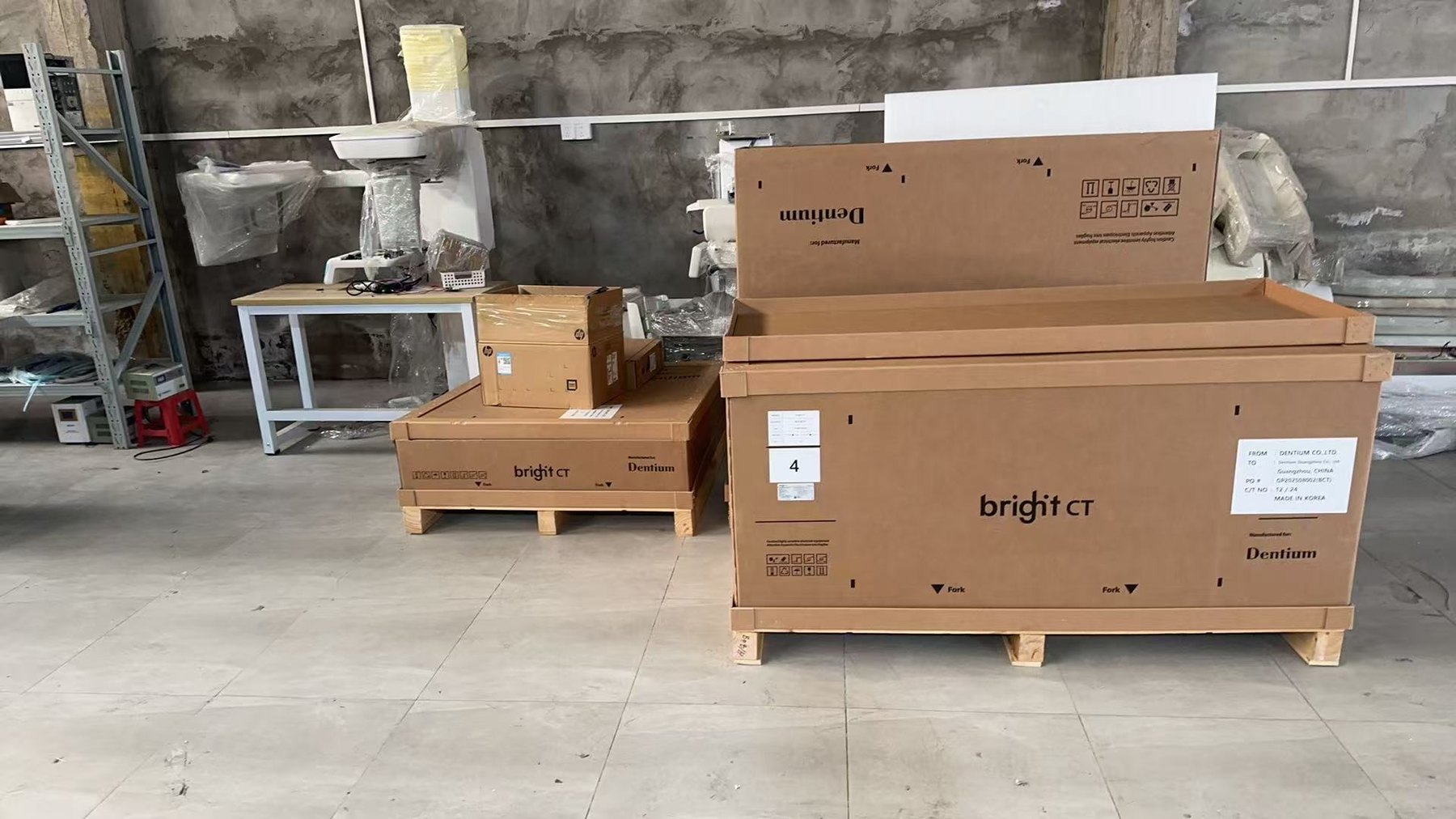
| Shipping crate count | 3 crates (Base / Body+WS / Ceph acc.) |
| Total net weight | 244 kg (538 lb) |
| Total gross weight | 350 kg (772 lb) |
| Largest crate | 1,760 × 720 × 1,408 mm · 230 kg |
Every system we ship — rainbow CT, bright CT, or anything else in the catalogue — goes through the same five-stage protocol at our Shanghai facility. No shortcuts.
Serial decoded (L-DD-DX-D-NN-YY), tube-hour count recorded, functional testing across all three modalities, chassis and movement assessment.
Detector clean, cable harness inspection, consumables replacement (chin rests, bite blocks), firmware verification (rainbowCT M & S boards).
Panoramic geometry calibration, CBCT geometric alignment across all three FOVs, cephalometric magnification verification, dose output checks.
Phantom scans: 5×5, 16×10, 16×18 stitched; panoramic; ceph (where applicable) — exported as DICOM for customer review.
Three-crate export packing (matches factory: Base, Body+WS, Ceph accessories). ISPM 15 plywood, 350 kg gross, full documentation pack.
Dentium Co., Ltd. is a South Korean dental manufacturer established in 2000, primarily known as one of Asia's leading dental implant brands alongside Osstem and Neo. Their SuperLine and Implantium implant systems are deployed in 70+ countries, and they have a strong Chinese-market presence via Dentium China (Guangzhou subsidiary).
The Rainbow CT is their in-house imaging platform — built specifically to integrate with the implant workflow, including a Dentium implant library inside the 3D Viewer for pre-surgical planning. For practices already placing Dentium implants, the ecosystem integration is material; for other practices, the Rainbow CT still stands on its own as a full-featured 3-in-1 system.
Same chassis, same generator, same CT/panoramic detector. The difference is cephalometric capability:
DX) — 3-in-1: includes the cephalometric arm and its dedicated CdTe CMOS detector. Supports Lateral, PA/AP, SMV, Carpus. $32–40 K.BC) — 2-in-1: CBCT + panoramic only, no ceph arm. Nearly half the footprint. $25–32 K.Important: bright CT cannot be upgraded to rainbow CT onsite after purchase. If you want ceph capability, buy the rainbow CT from the start.
Both are Korean 3-in-1 flagships in a similar price range, but they make different trade-offs:
Buy Papaya for FOV granularity and independent per-modality sensor architecture. Buy Rainbow CT for the biggest stitched FOV, implant-workflow integration with Dentium's library, and the bundled workstation.
Conventional dental X-ray detectors use a two-step conversion: X-rays hit a scintillator that emits visible light, which is then detected by a photodiode. CdTe (Cadmium Telluride) is a direct-conversion semiconductor — X-ray photons are converted to electrical signal in one step, skipping the intermediate light conversion.
In theory: less scatter at the scintillator stage, higher contrast-to-noise ratio per unit dose, cleaner edges on bony landmarks. In practice on dental ceph, the difference is most visible in fine skeletal detail during orthodontic tracing.
This is the same material family that PointNix uses for their CT sensor — Dentium applied it on the ceph side instead.
The original factory package includes a matched HP Z4 G4 tower with Intel Xeon W-2223, 16 GB ECC RAM, NVIDIA RTX 3050 8 GB, 1 TB HDD, Windows 10 Pro, plus an HP EliteDisplay E22 G5 monitor, pre-loaded with the full rainbow software suite.
Because we source pre-owned units, workstation availability varies per unit:
We confirm the exact workstation status and software licence situation when we quote. If a unit arrives without a compatible workstation, we can supply one separately at cost.
Every unit ships with the full rainbow software suite: rainbow 3D Viewer (CBCT viewer with MPR, Cross-section and implant planning), rainbow Image Viewer (2D main viewer for pano/ceph/intraoral), rainbow 3D Ceph (orthodontic analysis — Steiner, Ricketts, Bolton, PA, Simple Tracing, VTO/STO), rainbow DBServer (PostgreSQL 9.5 local patient database), rainbow CT (acquisition interface) and rainbow BackupRestore.
Implant planning is built in via the rainbow 3D Viewer's Implant Info module, which includes Dentium's own implant library (Implantium, SuperLine, NRLine) for direct virtual placement with live bone-density mapping.
DICOM 3.0 export lets you take the volume into third-party planning tools (coDiagnostiX, SimPlant, Blue Sky Plan, 3Shape Implant Studio, Anatomage InVivo) for non-Dentium implant systems or advanced workflows.
If the unit ships without the original Z4, target something matching the factory spec or better:
We can supply a pre-configured acquisition PC on request, or help spec one to local procurement.
Yes — the Rainbow CT platform remains in Dentium's active imaging catalogue and is actively sold, serviced and supported globally. Parts, firmware updates and software updates continue through Dentium's dealer network. Dentium's strong Korean-market and Chinese-market presence (via Dentium China, Guangzhou) means parts availability and local service coverage are particularly robust in Asia. For Western markets, parts are routinely available through authorised Dentium distributors.
Every shipment includes:
Warranty: 3-month limited hardware warranty on tube, generator, CMOS detector, CdTe ceph detector (extendable to 6 or 12 months on request). Installation and training videos/support provided remotely.
Not included: site preparation, electrical installation, radiation shielding, local import duties/VAT, customs clearance, inland haulage from destination port.
Under FOB Shanghai, we deliver the three crates to the vessel at the Port of Shanghai; ocean freight, insurance and destination handling are your responsibility or your freight forwarder's. Typical routing options:
We can also quote CIF terms if you'd prefer we handle ocean freight and insurance.
We run on WhatsApp and email — no forms, no lead-gen funnels. Messages hit our sales team directly and we respond within one working day.