Desktop Dental Milling Machines for Russian Dental Labs: Sourcing from Shanghai in 2026
How Russian dental labs source compact chairside-class milling machines from Shanghai — covering Roszdravnadzor registration, ruble FX settlement, payment routing after SWIFT disruptions, and Vladivostok / St. Petersburg port logistics.
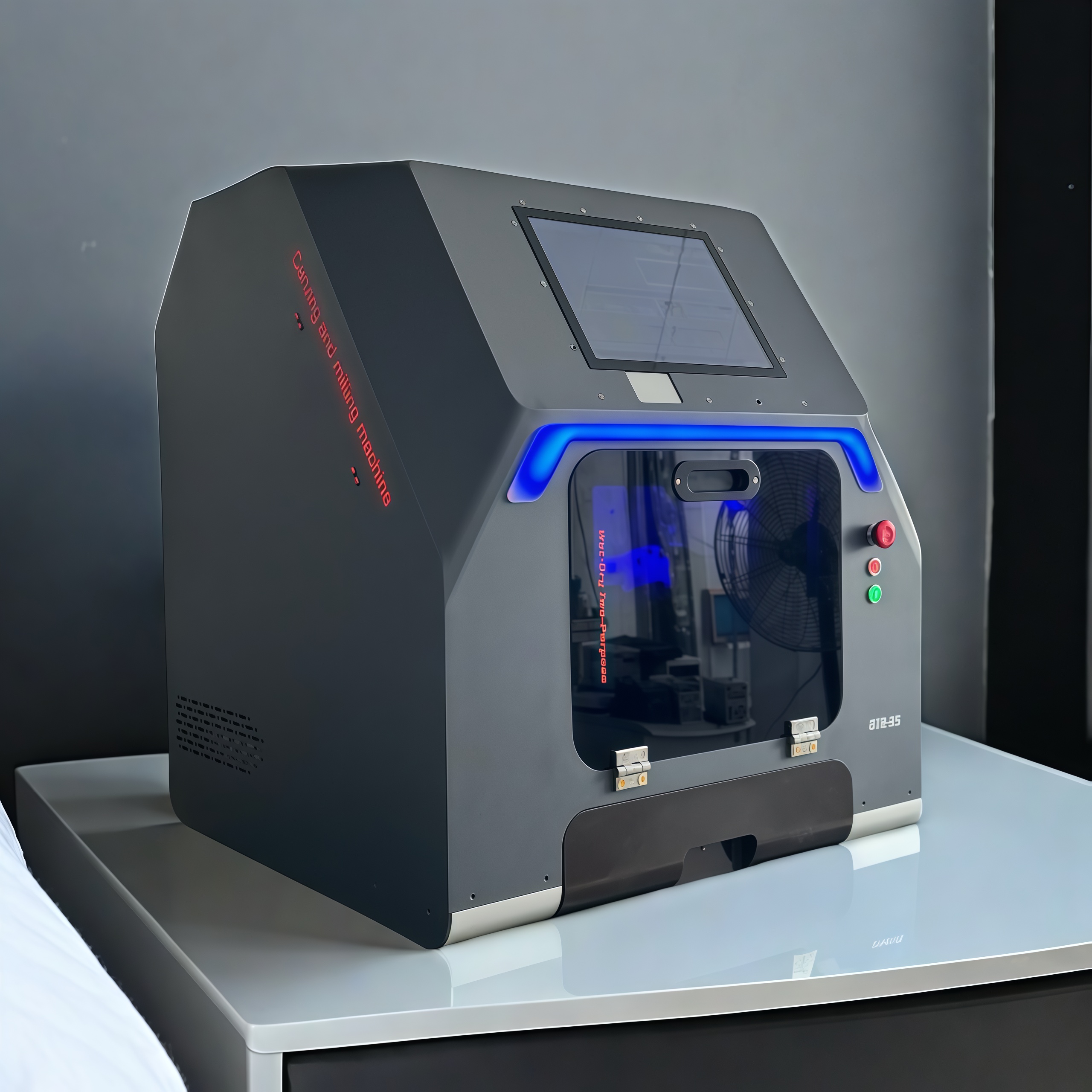
Russian dental labs are among the most sophisticated buyers of compact chairside milling machines we work with, and also among the most cost-sensitive since 2022. The sanctions environment restructured payment flows, shipping routes, and parts supply chains — but did not stop Russian lab owners from equipping their facilities. A recent inquiry from a Russian dental equipment supplier asking specifically about the "Xmachine XM-100" class of desktop milling unit captures the current pattern. This guide walks through sourcing from Shanghai in 2026, with emphasis on what actually works for Russian buyers.
"Xmachine XM-100 desktop mill"
— Dental equipment buyer in Russia (contact on file)
What the XM-100 class actually is
The "XM-100" naming convention spans several Chinese-manufactured desktop 4-axis and 5-axis dental mills in the 300mm × 400mm footprint range, typically designed for wet/dry zirconia, PMMA, wax, and composite resin block milling. These units target the mid-tier dental lab segment — labs producing 30–150 crowns per month who want in-house milling economics without the USD 45,000+ price point of a Roland DWX-52D or Imes-Icore CORiTEC.
Typical specifications for the XM-100 class we supply to Russian labs:
- 4 or 5 simultaneous axes with ±5 µm repeatability
- Brushless spindle, 40,000–60,000 rpm
- Wet/dry dual-purpose operation
- Open-architecture control: accepts STL/PLY output from Exocad, 3Shape Dental System
- Supports zirconia, lithium disilicate, PMMA, wax, composite resin, soft metal
- 10-inch HMI touchscreen, USB-based CAM file transfer
- Integrated water tank for wet milling, integrated vacuum port for dry dust collection
- Footprint roughly 420×480×530mm, weight 60–85kg — fits on a standard laboratory bench
The Russian dental lab market in 2026
Russia has roughly 2,800 registered dental laboratories, concentrated in Moscow, St. Petersburg, Yekaterinburg, Novosibirsk, and Kazan. The mid-tier lab segment (30–150 crowns/month) represents approximately 40% of total lab count and has been the most active buyer category for desktop mills since domestic ruble purchasing power recovered in 2023. Market characteristics shaping sourcing decisions:
- Price sensitivity is high: Russian lab owners reject Western European pricing premiums. A mill quoted at EUR 35,000 in Germany sells in Moscow at ruble-equivalent USD 12,000–15,000 because the alternative is buying Chinese-origin at that price directly.
- Service parts and blades are the long-run challenge: Spindle motors, ball screws, and carbide cutting tools are ongoing consumables. Russian buyers consistently ask about parts availability beyond warranty.
- Payment routing matters more than pricing: Since early 2022, Russian bank SWIFT access has been restricted for many institutions. Payment settlement via non-sanctioned third-country intermediary accounts has become standard practice.
Roszdravnadzor registration
Russia regulates medical devices through the Federal Service for Surveillance in Healthcare (Roszdravnadzor). Dental milling machines are classified as Class 1 or Class 2a medical devices depending on clinical use classification (in-office chairside vs. lab-only). For lab-only desktop mills intended for dental prosthesis manufacturing:
- The importer typically holds the Registration Certificate (Регистрационное удостоверение)
- Technical file: manufacturer ISO 13485, test reports from GOST-R accredited laboratory, Russian-language user manual
- Timeline for first-time registration: 6–10 months; repeat model registration: 2–4 months
- GOST-R compliance testing can sometimes be completed in Russia-compatible test labs in China (Shanghai has accredited partners)
For single-unit personal-use imports by lab owners, Russian customs has historically allowed imports under a simplified declaration if the device is for the buyer's own operational use (not resale). This works for one mill; it does not scale to a distributor model.
Shipping Shanghai to Russia: Vladivostok or St. Petersburg
Russia has two primary ocean entry points for Shanghai-origin goods:
- Vladivostok (Far East): Shanghai to Vladivostok takes 8–12 days port-to-port. Best option for buyers in Siberia and Far East Russia. Trans-Siberian rail from Vladivostok to Moscow: additional 14–18 days, USD 1,800–2,800 per 20ft container.
- St. Petersburg (Baltic): Shanghai to St. Petersburg via Suez: 45–55 days. Direct ocean route for European Russia. Shorter onward trucking to Moscow (1 day, USD 400–600).
- Air freight Shanghai to Sheremetyevo/Domodedovo: 5–8 days including customs. USD 4.50–7.00 per kg viable for single-unit milling machine shipments (approximately 85kg with packaging = USD 400–600).
For a single desktop mill, air freight to Moscow is typically the right choice. The per-kg cost vs. LCL ocean differs by only a few hundred USD, and the 2–4 week timeline compression is genuinely valuable when the lab is trying to launch a new service line.
Payment routing post-SWIFT restrictions
Cross-border payment to Chinese suppliers from Russia in 2026 typically uses one of three routes:
- Yuan-denominated settlement through Bank of China Moscow: CNY TT direct. Avoids USD settlement risk, is the cleanest route, and has become the default for China-Russia trade. Most Chinese suppliers accept CNY.
- USDT (Tether) or stablecoin settlement: Informal but functional. Buyer's third-country intermediary sends USDT; seller's third-country partner converts to USD or CNY. Used for smaller transactions.
- Third-country intermediary invoicing (UAE, Kazakhstan, Turkey): Buyer pays a Dubai-based or Istanbul-based trading company, which in turn pays the Chinese supplier. Adds 2–4% in intermediation fees.
The most reliable path for Russian dental lab buyers in 2026 is direct CNY settlement through Bank of China Moscow. Rates are published daily; conversion fees run 0.3–0.5%; the transaction settles within 1–2 business days.
Duty, VAT, and landed cost
Russian import duty on dental milling equipment (HS 8456.20) is typically 0–5% depending on EAEU tariff classification, plus 20% VAT (НДС) on the CIF+duty value. A worked example for a single XM-100 class unit at USD 14,500 FOB Shanghai:
- FOB Shanghai: USD 14,500
- Air freight to Moscow (SVO): USD 550
- Marine insurance / air insurance: USD 80
- CIF Moscow: USD 15,130
- Import duty 0–5% (varies): USD 0–756
- VAT 20% on CIF + duty: approximately USD 3,030–3,180
- Broker fees, terminal handling, inland delivery: USD 450
- All-in landed Moscow: approximately USD 18,600–19,500
For a lab producing 60+ crowns per month at average fee RUB 18,000–24,000 per unit (approximately USD 200–260), in-house milling payback on an XM-100 class investment lands in the 10–14 month range vs. outsourcing to a central milling service.
Tooling and consumables: the ongoing cost
The unit cost of the mill is only the headline. Ongoing tooling and consumables drive real total cost of ownership:
- Carbide cutting tools: 2.5mm and 1.0mm are the workhorses. Budget 8–15 tool changes per 100 zirconia crowns. Chinese-origin carbides at USD 8–18 per tool vs European at USD 25–45 per tool — clinically equivalent for most materials.
- Sintering furnace blocks and zirconia blocks: the lab's primary monthly consumable. Chinese-origin zirconia blocks (98.5mm × 14/18/22mm thickness) at USD 22–48 per block vs European at USD 45–95 per block.
- Spindle rebuild at 1,800–2,500 hours: USD 900–1,500 for a Chinese-origin compatible spindle vs USD 3,500–5,500 for OEM.
Sourcing a desktop mill for your Russian dental lab?
WhatsApp us with your production volume target, material mix (zirconia, PMMA, wax, composite), and destination city. We'll quote XM-100 class options with delivered-Moscow pricing, CNY settlement routing through Bank of China Moscow, and a Roszdravnadzor registration timeline if you plan multi-unit imports.
Chat on WhatsApp →