Launca DL300p vs Medit vs Shining 3D: Real Intraoral Scanner Comparison
An Iranian dentist asked whether the Launca DL300p is worth buying over Medit i700 or Shining 3D Aoralscan 3. Here's a field-tested comparison across accuracy, workflow speed, and open-architecture export.
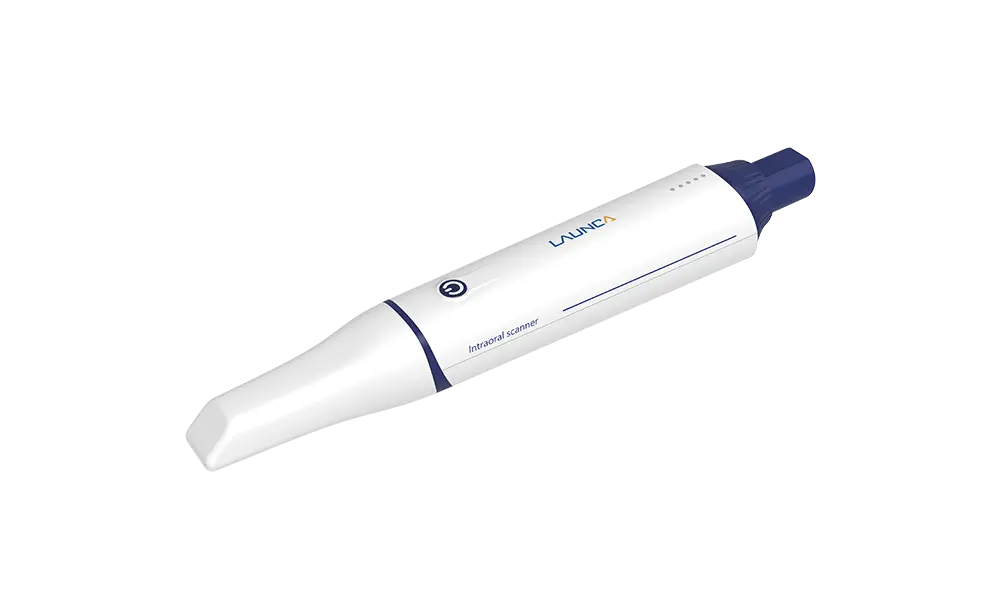
A dentist in Iran asked a direct question: is the Launca DL300p worth it for implant prosthesis and fixed partial denture work, compared to Medit i700 or Shining 3D Aoralscan 3? These three scanners cover roughly the same price bracket (USD 12K-20K) and nominal specs, but they behave differently in real clinical workflow. Here's a comparison based on actual use, not spec sheets.
Accuracy under ISO 20896-1
Published ISO 20896-1 accuracy figures (trueness, precision at full arch):
- Launca DL300p: 16 μm trueness, 12 μm precision (published)
- Medit i700: 10 μm trueness, 7 μm precision
- Shining 3D Aoralscan 3: 10.9 μm trueness, 6.4 μm precision
For most clinical cases these differences are invisible — crown margins, inlay fits, and implant abutment transfers all work fine at 16 μm. The gap matters only when you're doing full-arch implant prosthesis where cumulative error compounds across multiple implants. For those cases, Medit and Shining pull marginally ahead.
Scan speed and full-arch capture
Where Launca DL300p shines is wireless freedom and capture speed. Published full-arch times:
- Launca DL300p (wireless): 45-60 seconds full arch for a cooperative patient
- Medit i700 wireless: 55-75 seconds full arch
- Shining 3D Aoralscan 3 wireless: 50-65 seconds full arch
In practice, wireless speed is less about the scanner hardware and more about technique. A veteran scans all three in 40-50 seconds; a new user takes 90+ regardless of brand. Budget more for training than for the last 5 μm of accuracy.
Open architecture and export
For a lab doing varied work (Bluesky Bio, Exocad, 3Shape Design Studio), open export matters:
- Launca DL300p: exports STL, PLY, OBJ — fully open architecture, no subscription gate
- Medit i700: exports STL, PLY, OBJ — open but Medit Link cloud adds friction for non-Medit workflows
- Shining 3D Aoralscan 3: exports STL, PLY, OBJ — fully open, also exports DCM for implant planning directly
All three are open-architecture, but Shining's direct DCM implant export is a real time-saver if you do implant planning in Blue Sky Plan or DTX Studio.
Price and landed cost in Iran
Rough FOB Shanghai pricing (Iranian buyers usually route through UAE or Turkey due to sanctions on direct transfer):
- Launca DL300p: USD 12,500-14,500 FOB
- Medit i700 (Chinese gray market): USD 11,000-13,000 FOB (watch for counterfeits — buy only through verified Chinese reseller with serial-number-verifiable authenticity)
- Shining 3D Aoralscan 3: USD 14,000-17,000 FOB
For Iranian buyers, add UAE re-export handling (~5-8%) and final freight to Tehran (~USD 400-800). Medit's gray-market scanners in Iran have a real counterfeit problem; if you buy a "Medit" at USD 8K, it's not a Medit.
The honest recommendation
For the specific case described (implant prosthesis and FPD work, mixed Iranian clinic):
- If budget tight: Launca DL300p — you give up 6 μm of full-arch trueness but gain real price headroom, and 16 μm is clinically fine for 95% of prosthesis work
- If full-arch implant work is 20%+ of your case mix: Shining 3D Aoralscan 3 — the accuracy difference actually compounds on long-span cases
- If you already own Medit clear-aligner workflow or lab partnership: Medit i700 — the ecosystem lock-in is real and it's fine equipment
Our own DP/PD/CJ scanner line sits in a slightly different price bracket (USD 6K-10K FOB depending on model), with performance between Launca and entry-tier tethered scanners. For buyers where sub-USD 10K is the hard ceiling, those are worth a conversation alongside any of the three above.
Have a specific unit in mind?
Tell us which model you want and your destination port — we'll quote FOB or CIF with a video demo of the actual unit in our warehouse.